

Eagle
TSF · № 04


“It’s going to be total rock and roll.” —Trader
December 1986. “Ninety for three thousand, ninety for three thousand—fill or kill!” Orders shouted into a speakerphone to a runner across a trading floor. Behind him on the wall, a chart: the market before the 1929 crash traced onto the market of 1987, frame by frame. Minutes are passing and the market softens. He pauses for the worst of it, then laces on a pair of lucky sneakers. “These tennis shoes and the future of this country hang on them. I bought these at a charity auction. They are Bruce Willis’s, the man’s a stud.”
A PBS camera catches the footwork. He is thirty-two, and about to call the biggest crash since 1929.
Trader. Directed by Michael Glyn. One hour. Aired on PBS, November 1987.
*
Paul Tudor Jones was a welterweight. A hundred and forty-seven pounds with a fighter’s eye.
Memphis first. His father published The Daily News—the family paper since 1886, thirty-four years under his hand. Jones worked the desk through high school, took summer journalism courses at Memphis State, and edited the front page his last years of college. He ran a bygone days column: history from decades past—seventy-five, fifty, twenty-five years ago on a given day. Fact-find, distill, lead.
The byline was Paul Eagle.
At the University of Virginia he took the boxing title at nineteen, ran book for his fraternity, and graduated with what he later called a master’s in probabilistic theory. Then off to New Orleans to meet Eli Tullis—one of the largest cotton traders alive. Jones called him the toughest son of a bitch he ever knew. Tullis put him on the floor of the New York Cotton Exchange.
One afternoon, three Mississippi clients’ wives visited the office while the market was tearing through positions Tullis was holding across the board. He sat with them for forty-five minutes, smiling, poised, having a wonderful little chat. Jones would never forget it.
Festival season, a Friday morning. Jones fell asleep at his desk after a night out. A ruler pried his chin off his chest. “Son, you are fired.” He never told his parents.
E.F. Hutton took him on as a commodities broker. Three years of winning, then one overleveraged trade in July cotton cost his clients sixty to seventy percent of their equity. He nearly quit. He told himself, “Mr. Stupid, why risk everything on one trade? Why not make your life a pursuit of happiness rather than pain?” Bruised—he beat the count and rebuilt.
In 1980 he founded Tudor Investment Corporation on thirty thousand dollars from Commodities Corporation, the Princeton incubator that had also launched Bruce Kovner and Michael Marcus. Tullis, the man who’d fired him, became one of his first clients. Years earlier in New Orleans, Tullis had handed him a book from 1923. “The most important book I could read.”
He was twenty-six.
*
Peter Borish built the chart on the wall.
Former New York Fed, recruited to Tudor in 1985. He took the market structure preceding the 1929 crash and overlaid it onto 1987—mapping an Elliott Wave analog that read the psychology behind the price. The correlation was over 92 percent with a thousand data points. Part analysis, part art.
Borish was candid: “If it looks like a duck and it acts like a duck and it sounds like a duck, it’s probably not a chicken.”
Jones saw the opening. They shorted the market.
The camera watched him ride it—raw energy and adrenaline, the friction of a body trying to keep pace with a mind already three moves ahead. The sneakers, the overlay, an unrelenting grin. December 1986 was one of his worst days. Down six million dollars, nearly five percent of his assets. “You know the agony and ecstasy? This is what is known as the agony.”
1987. The market was in a full rally until August. In the months before October he entered the short, took the stop-out when the market reversed, got out fast, waited. Re-entered. Got out again. Each time the thesis held; each time the timing was early. He kept hunting the chart. The week of October 14, the market dropped 10 percent in three sessions.
October 19, 1987. Black Monday. The Dow lost 22.6 percent in a single session—the largest single-day percentage decline in American market history. More than five hundred billion gone in hours. Tudor returned 125.9 percent after fees that year. Jones made an estimated hundred million dollars on the trade.
He was thirty-three.
Afterwards, Jones asked Glyn to pull the film. He bought copies where they surfaced. Takedown notices followed every upload. VHS copies sold for hundreds. The film resurfaces and disappears.
*
Borish had laid one era over another and found the correlation. Sixty years earlier, someone else had read the same pattern—and Tullis had put that story in Jones’s hands before any of it began.
1921. A broker’s office downtown is thick with cigar smoke, a river of numbers clattering across the ticker. The opponent is not in the room. It’s animated in the tape—in the chest of the man reading it. He’s shadowboxing phantoms built of ignorance, greed, fear, and deadly hope. The shock of being right too early, which is the same as being wrong.
Jesse Livermore had been reading the tape since he was fourteen. He chalked quotes on a blackboard in a Boston brokerage for five dollars a week while grown men lost and made their paychecks watching money move. Edwin Lefèvre interviewed him and wrote a novel. Reminiscences of a Stock Operator—serialized in the Saturday Evening Post in 1922, and published as a book in 1923. It caught him at his peak, already mythic and not yet gone.
The book never went out of print. Underlined, annotated, handed across desks on a new trader’s first day. A hundred years of readers. Jones read it at twenty-one. “It was as if he spoke straight to my soul. I cannot remember a single time when I haven’t discovered something new.”
Livermore had told the world there is only one side to the stock market—not the bull side or the bear side, but the right side. Jones built the rest of his career around it. Play defense. Start fresh. Assume every position is wrong. The man learning from Livermore’s book was also trading against Livermore’s fate.
*
In 2010 a new annotated edition was published. Jones wrote the foreword. In it, a line that had been waiting for him since high school. He opened with an observation that every market has a story to tell—the trader who isn’t a great observer and listener will be late to it. Then he was asked why the book still mattered to a man who could have learned everything from numbers and screens. His answer went somewhere no one expected:
“Looking back on my education, I would say that journalism was the single most important element of my development as a trader and as a businessman, more so than any of the economics and business classes I took at the University of Virginia. Newspaper journalism teaches you to fact-find, analyze, condense a story to its most essential points, then communicate them from most important to least. …Far and away the best training any businessman, investor, or trader can have.”
Memphis. The bygone days column. Paul Eagle. The correlation held all the way back.
*
“I am always looking for the next Jesse Livermore.”
The overlay forecast the crash. It didn’t predict what comes after.
Sunday evening, 1986. The year before the crash, Jones saw a story on 60 Minutes and heard a calling. On Monday he was hunting a new position. Five benefactors were adopting classes in New York’s poorest neighborhoods, each choosing a borough and a school. Jones walked in late. Only one remained—they gave him Bedford-Stuyvesant.
He adopted eighty-six sixth-graders, with a promise of college scholarships if they finished high school. He reviewed their report cards himself. After-school programs, field trips, sports—report card night every quarter, and still the scores never moved. A Harvard researcher would later compare his class to a nearby school without the program. Graduation rates, dropout rates, test scores, teen pregnancies—no statistical difference. The only improvement: four times the neighborhood rate went to college, because Jones was paying tuition. The money moved. Nothing else did.
The day after Black Monday, Jones was convinced a depression was coming. He called Glenn Dubin, his old colleague from E.F. Hutton. “It’s happening. We’ve got to do something about it.” This time, the method came first. Find the programs where a small bet produces outsized returns for real people. Measure everything and kill what doesn’t work. The board covers all overhead and every dollar lands full. Jones, Borish, Dubin, David Saltzman, Maurice Chessa. Saltzman from the New York City Board of Education. Chessa knew the territory of Bedford-Stuyvesant.
Imagined over Chinese takeout in a bachelor pad near the United Nations. No office, phone, or address—they called it Robin Hood.
Fifty-two thousand dollars deployed in 1988. More than three billion since. The largest poverty-fighting philanthropy in New York City. Compounding, in the same direction, for nearly four decades. In Bedford-Stuyvesant, the after-school programs became a school—Excellence Charter School, the first all-boys public charter in the country. Ranked first out of five hundred and forty-three elementary schools within five years.
That is a heavyweight.
*
Summer 2008. Lehman would be gone in September. That fall I found the book, the documentary, and the Market Wizards interview—three analogs of the same man, arriving all at once, while everything else was coming apart.
* * *
The Find: Trader. PBS, 1987. Directed by Michael Glyn. One hour. Online appearances are brief. No legal path to purchase. Hen’s teeth and lightning.
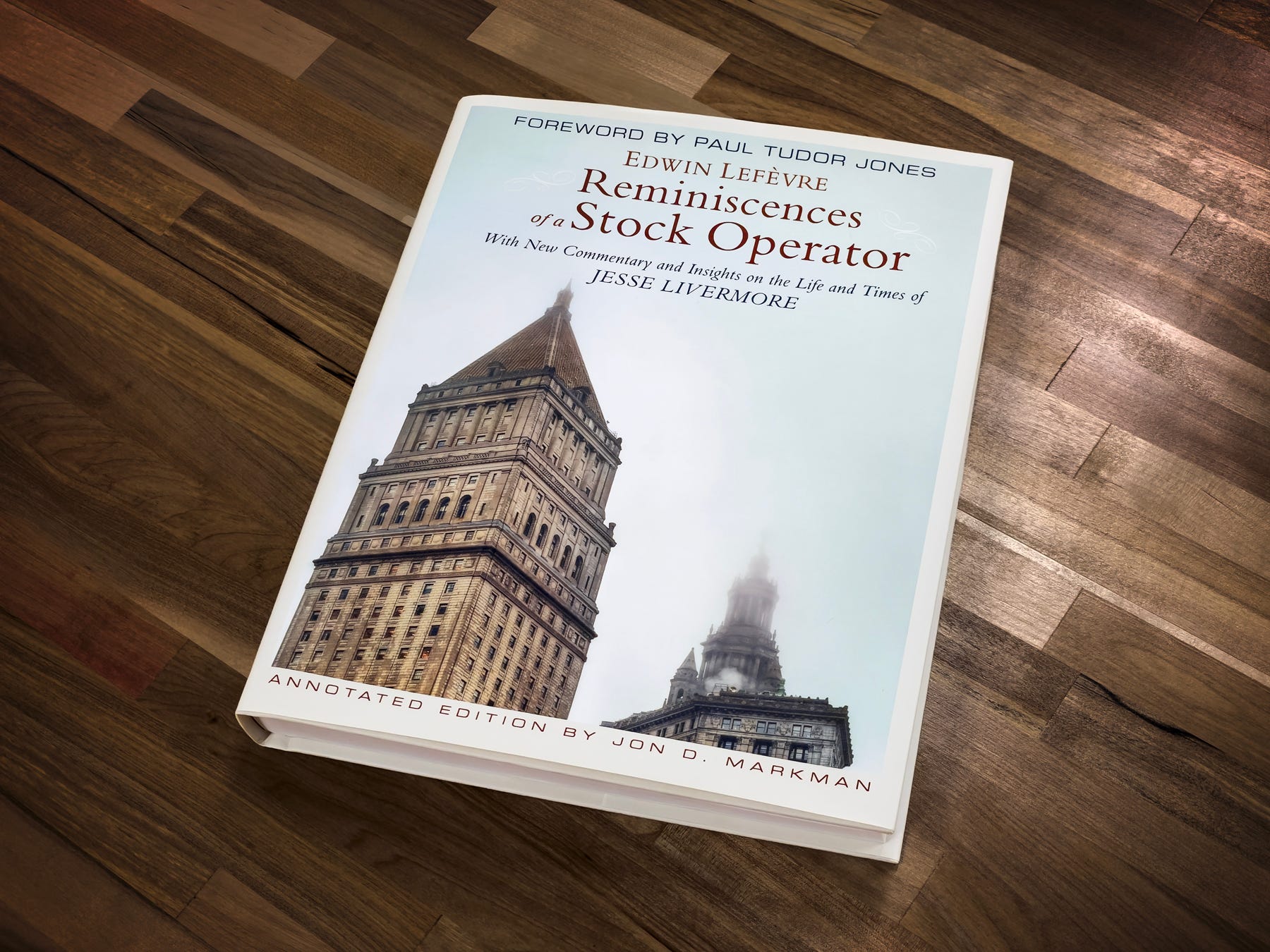
Edwin Lefèvre, Reminiscences of a Stock Operator. First serialized in the Saturday Evening Post, 1922. Published by George H. Doran, 1923. The 2010 annotated edition (Jon D. Markman, Wiley) carries Jones’s foreword.
Jack D. Schwager, Market Wizards: Interviews with Top Traders. Published by the New York Institute of Finance, 1989. The Jones chapter is “The Art of Aggressive Trading.” In print, available.
The Sunday Find is a collection of interests, ephemera, art, and obsessions. Subscribe if you want to see what I’m noticing.
Opening photograph: The Daily News · from the series Gotham.