

Me & Jerry
TSF · № 05

Jerry Reed was on the Cumberland River, catfishing, when the call came. He hadn’t shaved in days and smelled, by his own telling, “like a carp fest.”
RCA Studio B, Nashville, September 1967. Elvis Presley heard “Guitar Man” driving somewhere on the Ventura Freeway and couldn’t let it go. He went to Nashville to record the song. The session musicians worked at it all day and couldn’t get it down. Elvis wanted it like the radio, but it just didn’t sound right. His producer Felton Jarvis was an old friend of Reed’s and knew why. The players on the session were straight pickers. Reed was something other, and they weren’t going to get near it. Jarvis called Reed in off the river.
Reed walked into the session, picked up a gut-strung guitar, and retuned it on the spot—the low E down, B string up. He hit the intro and Elvis’s face lit up. The keeper was take twelve. Elvis asked if he had another song and they cut a second.
“I was toppin’ cotton, son.”
*
Merle Travis took thumb-and-index picking out of the Kentucky coal country—alternating bass with melody on top, one guitar sounding like two. The thumb held a bass line while the index finger carried the tune, and if you closed your eyes you’d swear there was more than one player on the stage. Muhlenberg County. That picking hand became the one Nashville learned first.
Chet Atkins heard Travis and added a middle finger, widening the pattern and building it into the style that powered Nashville for two decades. Certified Guitar Player—a designation Atkins invented because the existing titles didn’t cover what that hand could do.
Reed heard both of them and then brought the whole hand. Nobody taught him—he listened to Travis and Atkins and came out the other side bending ears and playing like neither of them had heard before.
Rich Kienzle, writing Reed’s obituary in Vintage Guitar, traced the lineage as: “If Travis’ thumb and index finger picking style was first generation, and Chet Atkins’ use of thumb, index and middle finger was second, Reed’s use of his entire right hand to pick was the wild, untamed and dauntingly complex third generation.”
Travis, Atkins, Reed. Lindsey Buckingham, Paul Simon, and Eric Johnson heard them. A whole generation of guitarists outside Nashville discovered fingerpicking and the road ahead changed. The recordings are out there—you hear the cascade ahead of placing the notes. Imagine the right hand. You can’t track what it’s doing. Thom Bresh, Merle Travis’s son, asked him where he dreamed up the lick for “The Claw.” “I don’t know,” Reed said. “It’s just one of those fits you pitch.”
*
Tommy Emmanuel once asked Reed how he ended up playing that way. Reed told him he was just trying to be like Ray Charles. Ray played piano in conversation with himself—right hand answering his syncopated vocal line and the left hand walking a blues bass underneath. A sermon in two hands. Reed’s guitar picked up the same conversation—melody lines, harmony, and a rhythm section, arriving as one complete thing.
He tracked down a Martin D-28 herringbone in 1952, bought while he was working at Exposition Cotton Mills. “The first time I put my earbone down to that thing and hit that big E chord and listened to that ring for about three minutes. I’ve died and gone to heaven.”
Nashville was harder. The studio veterans—Floyd Cramer, Grady Martin, Ray Edenton, Buddy Harman—owned the room, and Reed couldn’t breathe in it. “My face looked like one of them candy apples you get at the fairground.” He told Atkins he was going back to Atlanta where he could be hated amongst his friends. Atkins told him to relax. Reed knew he couldn’t be another Atkins, couldn’t be another Travis—didn’t want to be.
“Well, hell with it. I play what I play. And they don’t like fingerpicking. Fine. That’s what I do.”
He found an electric gut-string at a Gretsch convention, plugged it in, and that became the sound—louder than the drums, stranger than anything Nashville had a name for. He once left his Guild leaning against the back fender of his Lincoln. Forgot it was there, and backed over it. Every accident he’d ever had, he liked to say, had been backing up.
*
Atkins signed Reed to RCA in 1964. He was the L&N freight out of Nashville and only picking up speed.
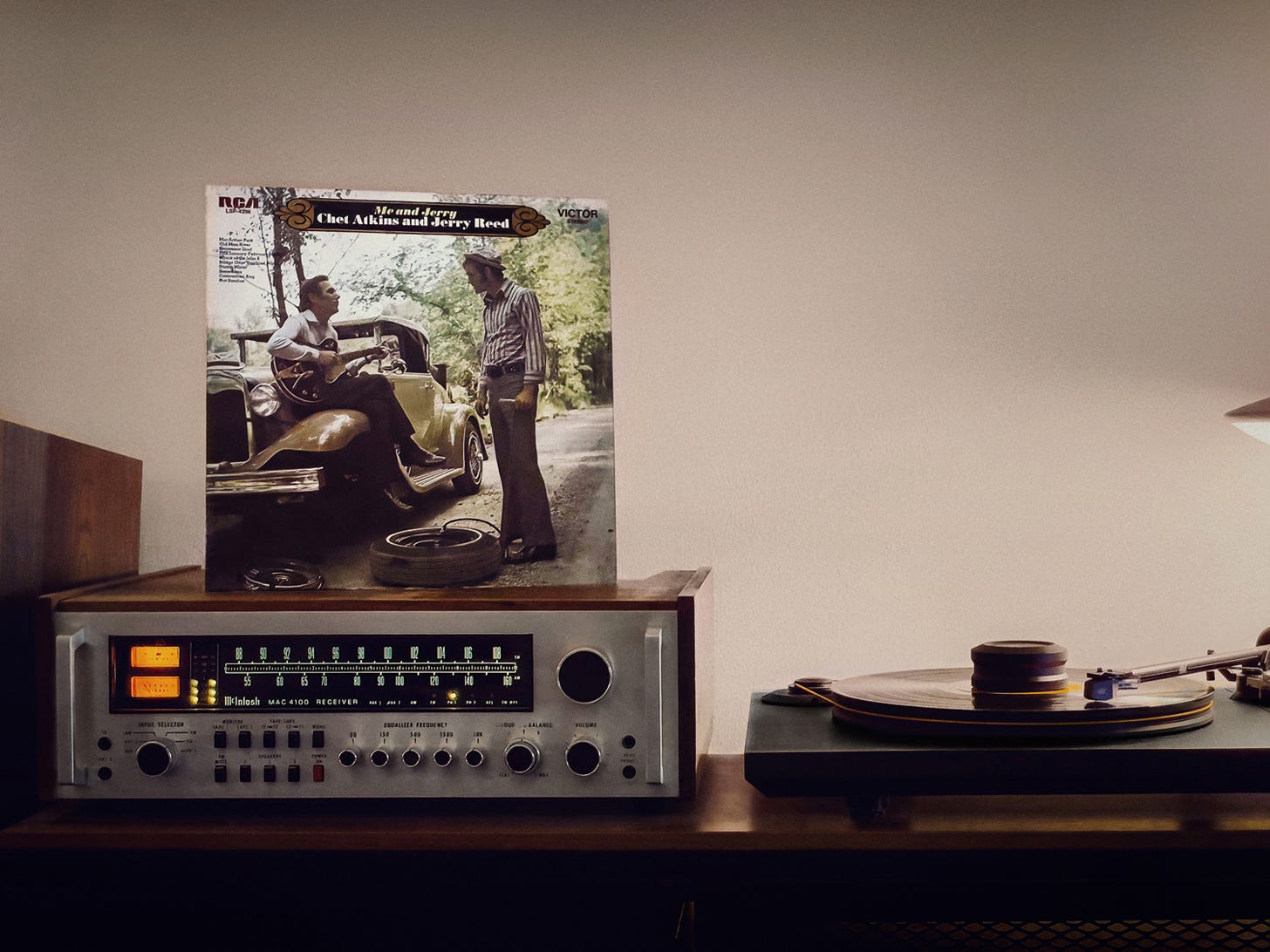
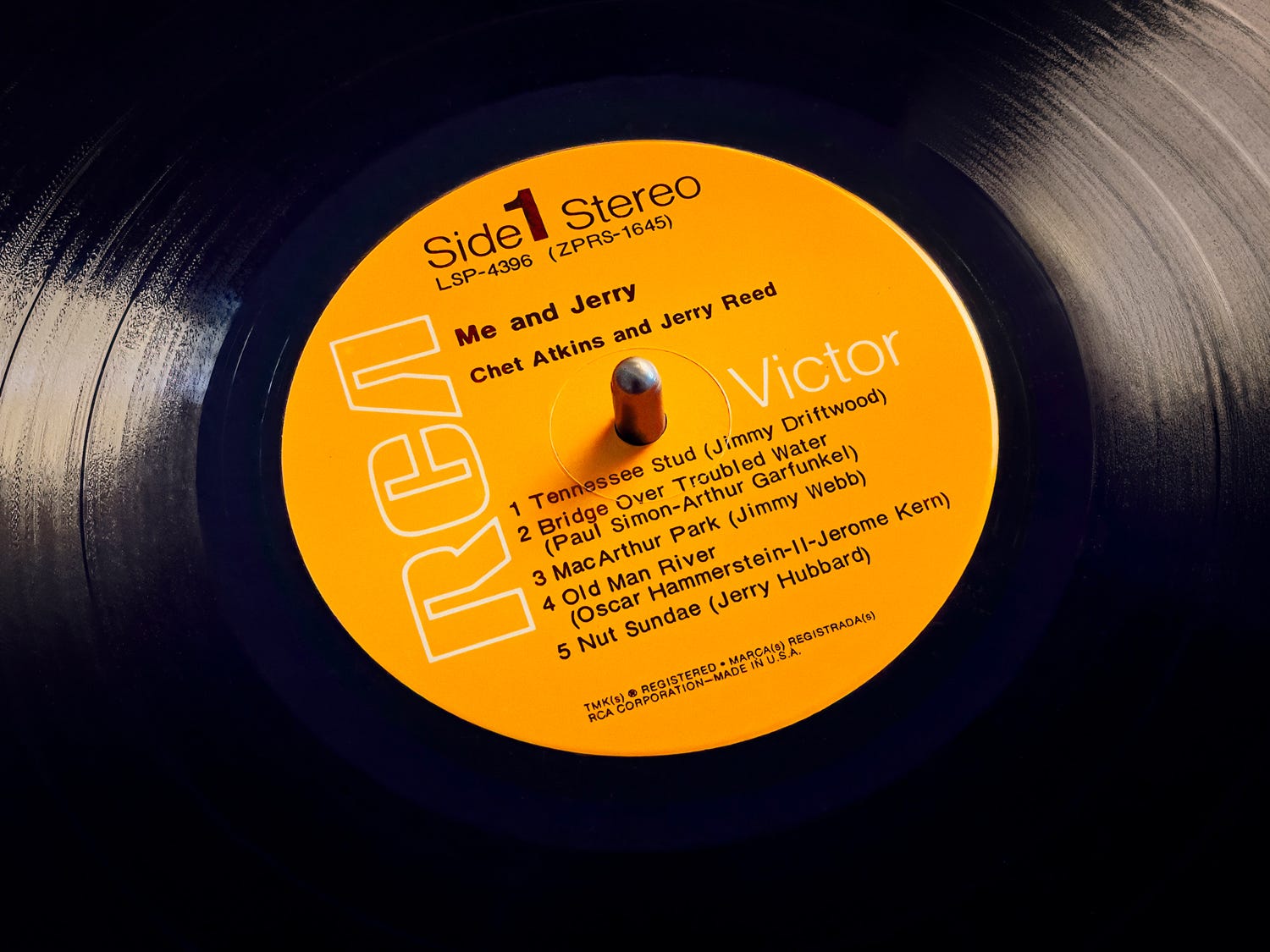
Me & Jerry came in 1970. Two guitars over a light rhythm section, bare studio sweetening, just Atkins and Reed picking at each other across the room. The whole record is two guitarists listening. RCA Nashville. Grammy for Best Country Instrumental Performance. Me & Chet followed in 1972. Reed co-produced it and wrote the liner notes. The billing flipped: Chet Atkins & Jerry Reed became Jerry Reed & Chet Atkins. Another Grammy nomination. Both were Certified Guitar Players. Atkins had made Reed the first. Two album titles and two lifelong friends—the ampersand holds them.
“Chet is the seed,” Reed said. “Everything that happened for me from then on had been for Chet. I’d have never been on the Goodtime Hour with Glen. If I hadn’t been on the Glen Campbell Goodtime Hour, I’d have never done the movie in Nashville with Burt.”
Reed and Burt Reynolds made five films together. They were fast friends and it showed on camera. In 1976 came Gator, with Reynolds asking Reed to play a 155-pound heavy with a sawed-off shotgun.
Smokey and the Bandit blew it wide open in 1977. Hal Needham, a stuntman turned director, had originally written Reed as the Bandit. Reynolds entered and took the lead. Reed got the truck, the basset hound, and a character the whole country would remember. Cledus “Snowman” Snow. “Smokey and the Bandit was just a hoot,” he said later. “All we did was run up and down those Georgia roads wrecking cars and having the time of our life.”
He wrote the chorus to “East Bound and Down” on the drive home. Called Dick Feller in, asked for two quick verses. Feller had them in two hours. Needham heard the demo and told Reed if he changed one note he’d kill him.
Nothing outran it that year except Star Wars.
I saw him pick on Hee Haw on Saturday nights as a kid—as full of wonder now as it was then. When I listen to his playing, it sounds inevitable, effortless. It’s like he just wanted me to smile.
*
“We were in Nashville and have you ever heard of a guitar player called Jerry Reed? He’s a really good American. Anyway, I was talking to him one night and I was saying I was going to go out on the road and he said, ‘Man! If I was Paul McCartney, I’d buy the road!'”
—Paul McCartney, Wings Over the World (1979)
*
Reed died in Nashville in 2008.
He composed seventy instrumentals with Atkins, released forty-eight albums, and won three Grammys. In his last years, he turned that energy toward wounded veterans, visiting hospitals, raising money, calling it the proudest work he’d ever done. His final album, The Gallant Few, came out the year he died—songs for the people he’d come to call his ministry.
“For 50 years, all I’d done was take, take, take,” he told The Tennessean the year before. “I decided from now on it is going to be giving. And I’m way behind. We’re all way behind. We live this life like what’s down here is what it’s all about…
“We’re temporary, son, like a wisp of smoke.”
* * *
The Find: Me & Jerry (1970) and Me & Chet (1972)—Chet Atkins and Jerry Reed, two guitars trading. The 1998 One Way Records reissue puts both albums on a single CD. If you’re looking for originals, clean vinyl runs $25 or less.
Then Sneakin’ Around (1992, Columbia). Twenty years after Me & Chet, Reed and Atkins made a third duo record, with pal Mark Knopfler sitting in on two tracks. It won the 1993 Grammy for Best Country Instrumental Performance.
⁂
On top of a pile of stove wood at five with a piece of bark for a pick—got his first guitar at seven. His mother taught him G, C, and D. Said he picked up E, A, and F on his own.
Off to the races, son.
The Sunday Find is a collection of interests, ephemera, art, and obsessions. Subscribe if you want to see what I’m noticing.
We've got a long way to go and a short time to get there. It's cool to see the finds stacking up.