

Small Fires
TSF · № 03

Like a color burned within the City’s promise.
For fifty years a lit cigarette was New York’s everywhere. The diner booth, the end of a telephone cord, a conversation ending on a rainy street. You could pause, think—disappear into the smoke and return with something solved. I know it’s too romantic. But the myth was real, and so was the collage it left on the sidewalk. Millions of remnants from small fires, and what they had held.
On January 2, 1971, cigarette advertising was banned from American television and radio. That same year, Alexey Brodovitch died. He had been art director of Harper’s Bazaar for a quarter century, the man who told photographers to astonish him. And he was never without a cigarette.
In 1972, Irving Penn started picking them up.
*
For three decades, Condé Nast had a standing instruction for its Vogue photographers: make this dirty ashtray beautiful. Make it worthy of a museum, or you’ll never be a photographer. Penn spent those decades doing exactly that. The visual language of postwar elegance—most of it his.
He was tired of the persuasion. Speaking to students, he put it plainly: “Since I have been a commercial photographer almost all of my professional life I have come now to yearn for a personal photography that does not try to manipulate anyone.”
In the spring of 1963, Penn traveled to Rochester with a workshop group led by Brodovitch and walked into the George Eastman House. He encountered platinum prints made by nineteenth-century photographers and was staggered. “They had a love for the print,” he said, “and that was the end for them, there was nothing else.”
He taught himself the process. Platinum and palladium in solution, hand-coated onto cotton rag. He began by remaking negatives from his own archive. Images that had lived their whole lives in magazines, now rendered in precious metals. Slowly, the process consumed him.
*
“Evenings as I walked from my studio to the train station I saw at my feet a treasure of the city’s refuse,” Penn wrote, “intriguing distorted forms of color, stain, and typography. The gutters were rich with cast offs flattened and reformed by rain and traffic.”
Cigarettes: the first body of work he conceived entirely for platinum.
He sent an assistant into 1970s Manhattan with a collection box lined with soft paper and a pair of tweezers. The instruction: disturb nothing. Keep the grit, the burnt tobacco, whatever else had attached itself. Penn reviewed what came back and was particular. He only wanted the ones with character. The stepped-on ones, the flattened ones—set aside. The character had to remain intact.
He wrote nothing about why he started. His notes on 1972 record only the work: “Over a period of some weeks, made a collection of cigarette butts of different shapes, sizes, and states of damage. It took about five days to make the camera negatives desired.”
He photographed them with an 8×10 camera and made enlarged internegatives. He then contact-printed those negatives onto Rives paper he had coated by hand. Each print roughly twenty-three by eighteen inches. Still lifes of singles and pairings at the scale of a torso.
During the week, he shot for Vogue in Manhattan. Weekends and holidays he drove to Long Island, to a platinum laboratory he’d built in a former horse stable on the family’s farm. His processing sink was a stainless steel basin from a decommissioned battleship, purchased in the Bowery.
Platinum is the most permanent photographic printing process and the least forgiving. The metal stains the fiber of the paper, not the surface. Penn had other ideas. Multiple coatings per sheet. Bonded to aluminum. Exposed multiple times through pin-registered negatives in vacuum frames under an 8,000-watt xenon light. He painted the solutions himself, coating and exposing each sheet in passes—more like offset printing than anything belonging in a darkroom. Penn burned a depth into the paper that no single exposure could hold.
He wrote it into the work:
Platinum-Palladium.
Hand-coated by the photographer.
No more than 46 original prints of this picture will ever be made.
As he worked, coating thousands of sheets—he murmured: “I am possessed, possessed by these cigarettes.”
From ashes, every one rendered in noble metals that will outlast the building it hangs in. The eye that made Lisa Fonssagrives luminous looked down at a waterlogged butt on Lexington Avenue and thought: that.
The negatives took five days. The prints took fifteen months.
*
In May 1975, John Szarkowski hung fourteen of the prints at the Museum of Modern Art. Penn’s first solo exhibition there. Szarkowski had offered the show weeks after seeing the prints in Penn’s studio.
Gene Thornton, writing in the Times, called them “truly Samuel Beckett cigarette butts—ugly, disgusting and insistent”—then imagined what Penn would have made had he photographed roses instead. With roses, only pretty pictures. With cigarette butts, “minor masterpieces of modern art.” He was right, but for the wrong reason.
What the critics missed was the printing itself.
Szarkowski saw it immediately. The subject, he noted, was “the occasion rather than the reason for the picture.”
*
Penn printed in platinum for nearly forty years—more than nine thousand six hundred prints—before the materials themselves gave out. Kodak discontinued the films. The xenon lamps became scarce. He was eighty-three.
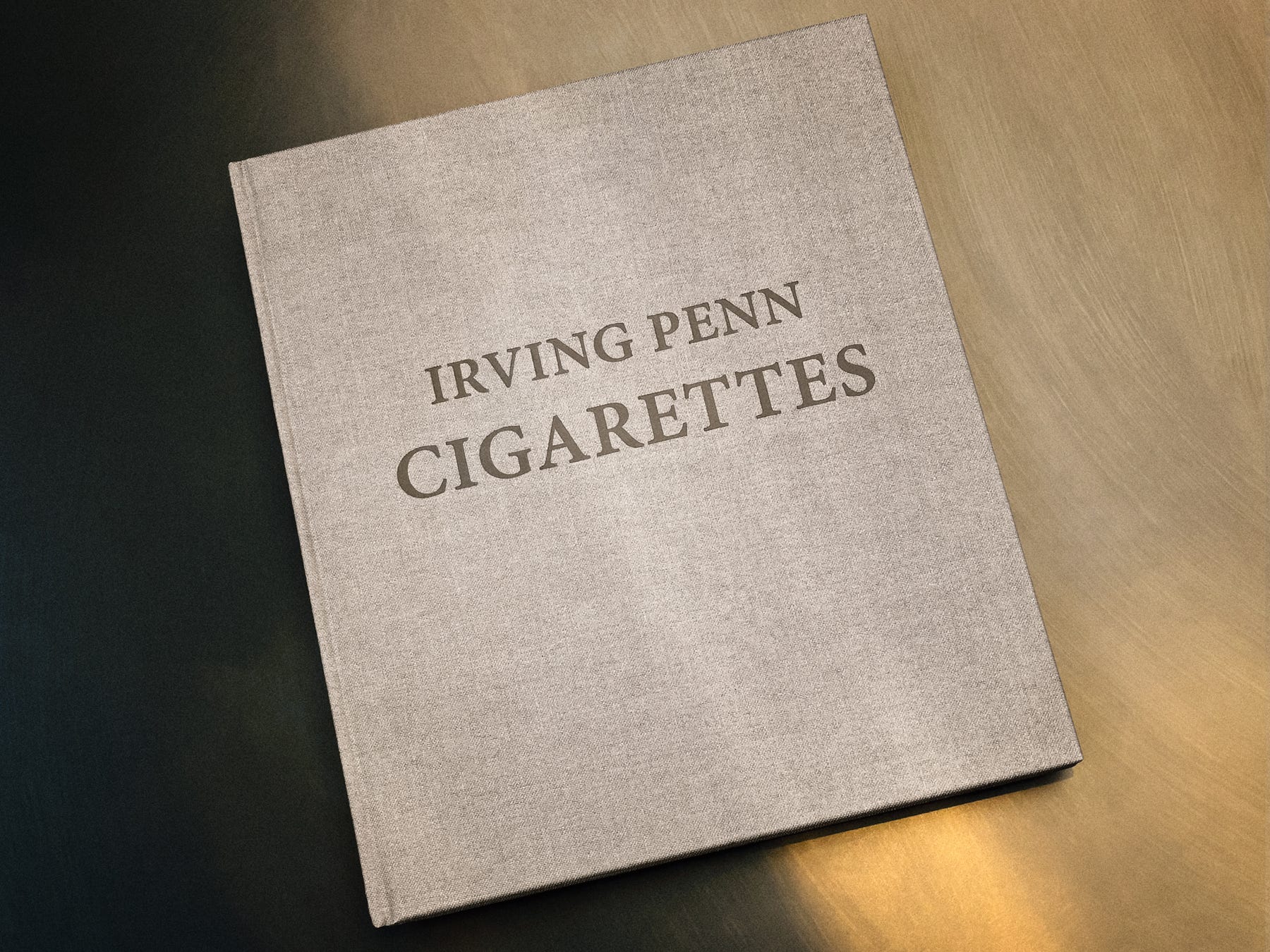
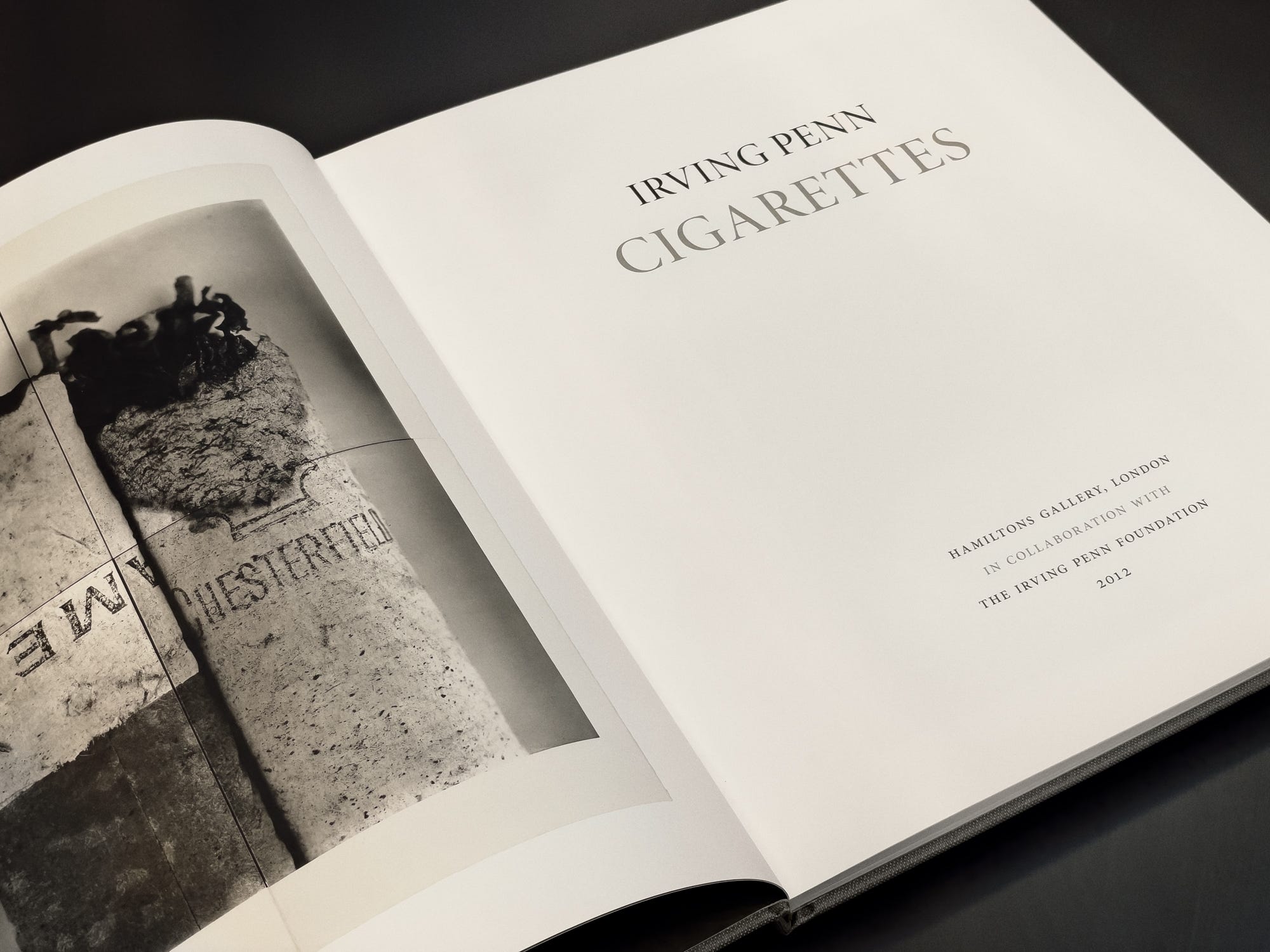
In 2012, Hamiltons Gallery in London published Irving Penn: Cigarettes—the first time all twenty-six prints appeared in a single volume, thirty-seven years after that charged exhibition. Tim Jefferies, who represented Penn’s studio for a quarter century, brought the prints together from collections around the world. Vasilios Zatse—Penn’s studio assistant, the hands that had been in the room—designed the book. Thomas Palmer—who worked in offset with Richard Benson and Penn himself—made the quadtone separations. Szarkowski’s 1975 text is reprinted inside.
Penn moved photographs from commerce to art to poetry.
*
I saw his platinum prints early in my career. Penn was the realization that I had been making pictures—and that somehow, on the other side of craft and extraordinary will, was a photograph. I wasn’t the same after. Years later, at the Centennial exhibition at the Met, I stood in front of them again. Complex and substantial—meditative and sculptural. Metal holding light inside the paper—not on it, not above it, in it.
Alchemy.
Turn to any page. Nothing in it is trying to convince you of anything.
* * *
The Find: Irving Penn: Cigarettes · Hamiltons Gallery, 2012 · Cloth-covered hardback, fourteen by twelve inches, sixty-five pages · Printed by Meridian on Mohawk Superfine. Lush in the hand, holding the depth of the prints.
So well made it feels inevitable · £150 · hamiltonsgallery.com
The Sunday Find is a collection of interests, ephemera, art, and obsessions. Subscribe if you want to see what I’m noticing.