

Tranquility
TSF · № 06

“You sure sound clear down there, Bruce. Sounds like you’re sitting in your living room.”
—Apollo 11 air-to-ground, July 16, 1969
The picture is mostly ghost. That summer evening on televisions across the world a bright figure moves against a black with no depth in it—edges flaring, every gesture trailing a faint copy of itself. The camera sending it weighs seven and a quarter pounds and draws six and a half watts, about what a night-light asks. It speaks slow-scan: 320 lines at ten frames a second, doing the work of thirty. The signal is thin enough to ride the radio link on almost nothing.
No network can air it as it arrives. At the three receiving stations—Goldstone in the Mojave, Honeysuckle Creek and Parkes in Australia—the fix is optical. The transmission plays in stop motion on a ten-inch monitor, and an RCA camera stands facing the screen, re-photographing the glow off the phosphor. That second image is what goes out. By satellite to Houston, microwave to New York, on to the networks—softer and grayer at every hand-off. What the world watches tonight is a photograph of a screen.
And for its first minutes, the picture hangs upside down. The Westinghouse flew bolted into its pallet on its head. The top was its only flat surface, and the converter switch built to right the image is set the wrong way when the feed comes up. Breaking across the loop, a voice—“Man, we’re getting a picture on the TV.” On the monitors the ground is the ceiling, and a man backs down a ladder and steps into the stars. The capcom, Bruce McCandless, reads the picture like a weather observer: contrast heavy, image inverted, detail fair. Inside the minute, somebody throws the toggle. The Moon turns over and settles into place.
*
The whole time a second camera is working, and it sends nothing. A Hasselblad sits on a bracket on Armstrong’s chest—silver against the heat, no viewfinder or meter, the trigger underneath. To aim it, he turns. Exposure is arithmetic done on Earth. Settings come off a cue card on the wrist; corrections are read up to the Moon by voice. Each frame recorded on seventy-millimeter film.
When the walk is over, the film rides the line up to the cabin. The lunar equipment conveyor is a clothesline in everything but name. Only the magazines return. Weight goes out so the rocks can come home.
The transmission ends and the cameras stay.
*
The Hasselblad you can own is the civilian sibling, and it asks for patience before it asks for film. You carry it at your waist and look down, and the world floats up at you off the ground glass. It comes at you bright, square, and reversed, left trading places with right. Step toward a thing and it slides the wrong way. You learn to steer backwards.
The crank turns with the sound of a watch being wound—one stroke advances the film, cocks the shutter, sets the mirror. Trip the release and the whole event happens at once: the mirror swings up, the screen goes black, the leaf shutter inside the lens opens and closes. The picture is no longer in front of you. It is inside, latent, waiting on a strip of film you can hold to a window in an hour or in fifty years, and the image is there. Wind on, and the world comes back to the glass.
Twelve frames to a roll. Twelve is few enough to count, and you find yourself counting. Every press of the button is a small verdict, reached before the shutter opens: this one is worth a frame. You let two pictures go to keep one. The roll comes back as twelve squares, and the negative is the receipt. Proof of where you stood, printable for a century and more.
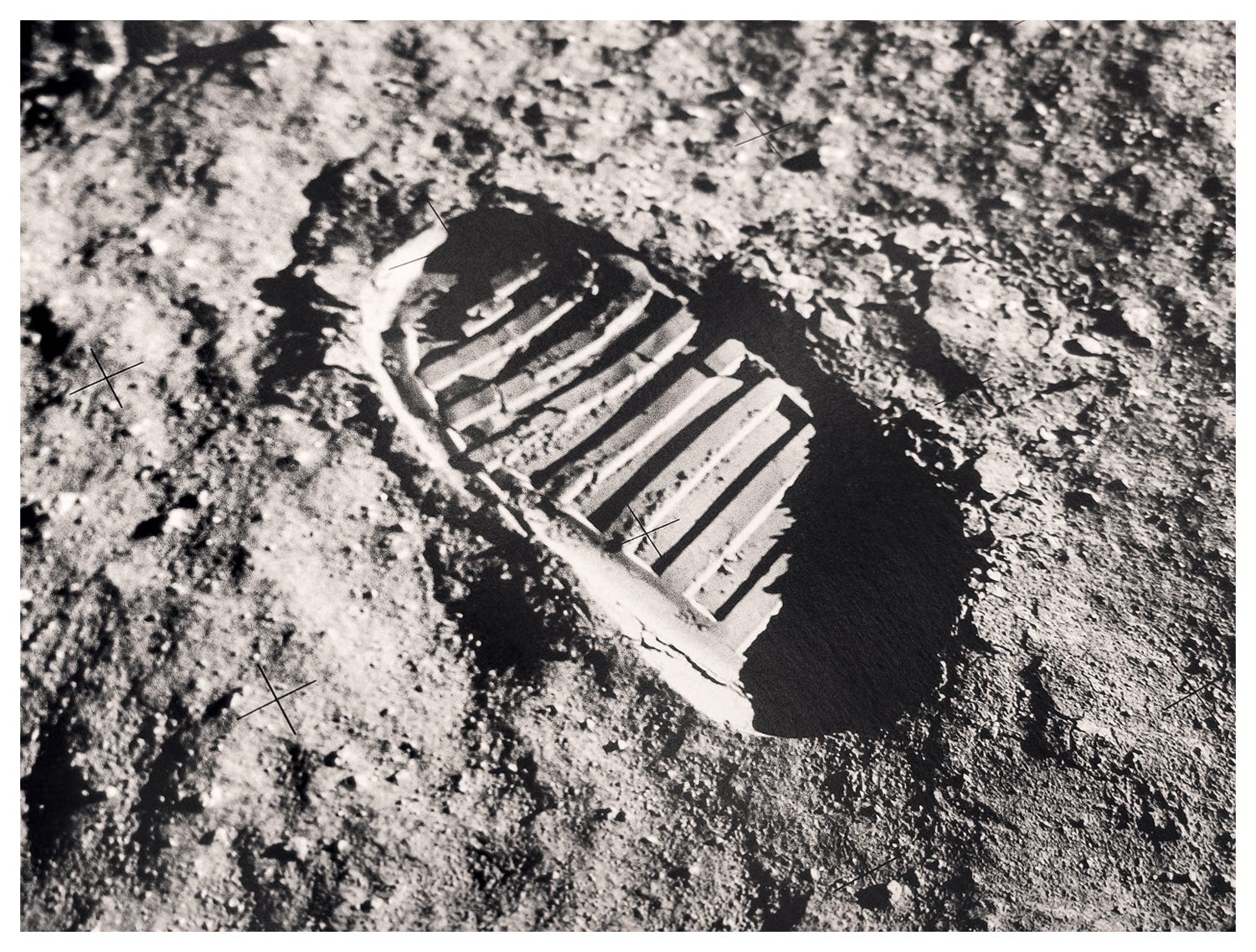
What flew was the motorized one—a 500EL built out for the suit, cross-marks printed on every frame for the map-makers. Yours is the mechanical line. It runs on springs.
*
Keeping a negative costs almost nothing—a sleeve, a drawer, the dark. Memory worked the same way long before film: to hold a thing, you framed it in a room of an imagined house. Robert Polidori has spent his career after the real ones—the rooms themselves, and what they keep. He grew up during the birth of the space program, an engineer’s son. His father worked at NASA’s Michoud Assembly Facility in the years it was building the Saturn V first stages, including the one that launched Apollo 11.
In December 2012 Polidori walked onto a stage in Berlin beside his publisher Gerhard Steidl and set out the ledger:
“In film it’s front loaded—it cost you to click, it costs you to develop, it costs you to make the print, but it costs you nothing to save. In digital it costs you nothing to click. It costs you time in editing, it costs you time and money in constant storage and re-storage, data transfers…”
He had just sold a loft. The most expensive room in it was five feet by eight—forty square feet, air-conditioned. A server room. “I have two hundred thousand dollars in there just for storing digital. Check that out.”
The analog, he said, was “an ideal, a love that you treasured.” The costless picture had a use of its own: to expurgate, to cut an experience out of your life so it never has to be lived again. Steidl put it back to Polidori as the single line he is often quoted for—analog is made to remember, digital is made to forget. Polidori allowed it and smiled, adding that sometimes forgetting is necessary.
*
The July broadcast had a master. At the three stations, as the signal was converted, it was also recorded raw. The slow-scan itself was captured straight to telemetry tape, sharper than anything that reached a living room. About forty-five reels. In 2006, when researchers went looking, the reels could not be found. NASA searched for years. The conclusion, in 2009: almost certainly erased in the early 1980s and reused. The agency had been short of tape. The master is gone, and even that was only ever a generation down. The photograph of the screen survives.
The film would have another life. The magazines that went up the line live in Building 8 at the Johnson Space Center, in a freezer at zero degrees Fahrenheit. The originals do not leave the building; to be scanned, a canister thaws for two days before anyone may touch it. NASA copied everything at the start, and nearly everyone who has ever worked with these pictures has worked from the copies—the scientists included.
The sun made them, and the sun is all you need to see them.
*
I was newly arrived the summer of the landing, asleep on the planet they had just left. For years I would lie on my back in the evening grass, underneath the fireflies, imagining what it felt like to look back at us. Cassiopeia, Polaris, the moons of Saturn. I loved the names. You can find the Sea of Tranquility on a clear night, and the footprints remain. A man walked on the Moon, and we made pictures.
April 2026. Four astronauts left Earth orbit for the first time since 1972.
* * *
The Find: Full Moon · Michael Light · Alfred A. Knopf, 1999. For the book, NASA let nine hundred of the Apollo master negatives and transparencies leave the building to be scanned—the first time it ever had. Light sequenced a hundred and twenty-nine of them into one flight out and back, five gatefolds opening to forty-five inches, printed in Luna Nero, a bespoke black ink. Long out of print; clean copies turn up used.
The camera—the civilian sibling. The fully mechanical V-system: 500C/M (1970–1994) or the better-finished 501CM that followed, same square, twelve frames to a roll, speeds to a five-hundredth, no battery. A body with an 80mm Planar and a film back runs $1,500–3,500 used, depending on condition and era.
The flown cameras have no price. Twelve Hasselblads left on the surface—the Sea of Tranquility holds one.
The Sunday Find is a collection of interests, ephemera, art, and obsessions. Subscribe if you want to see what I’m noticing.
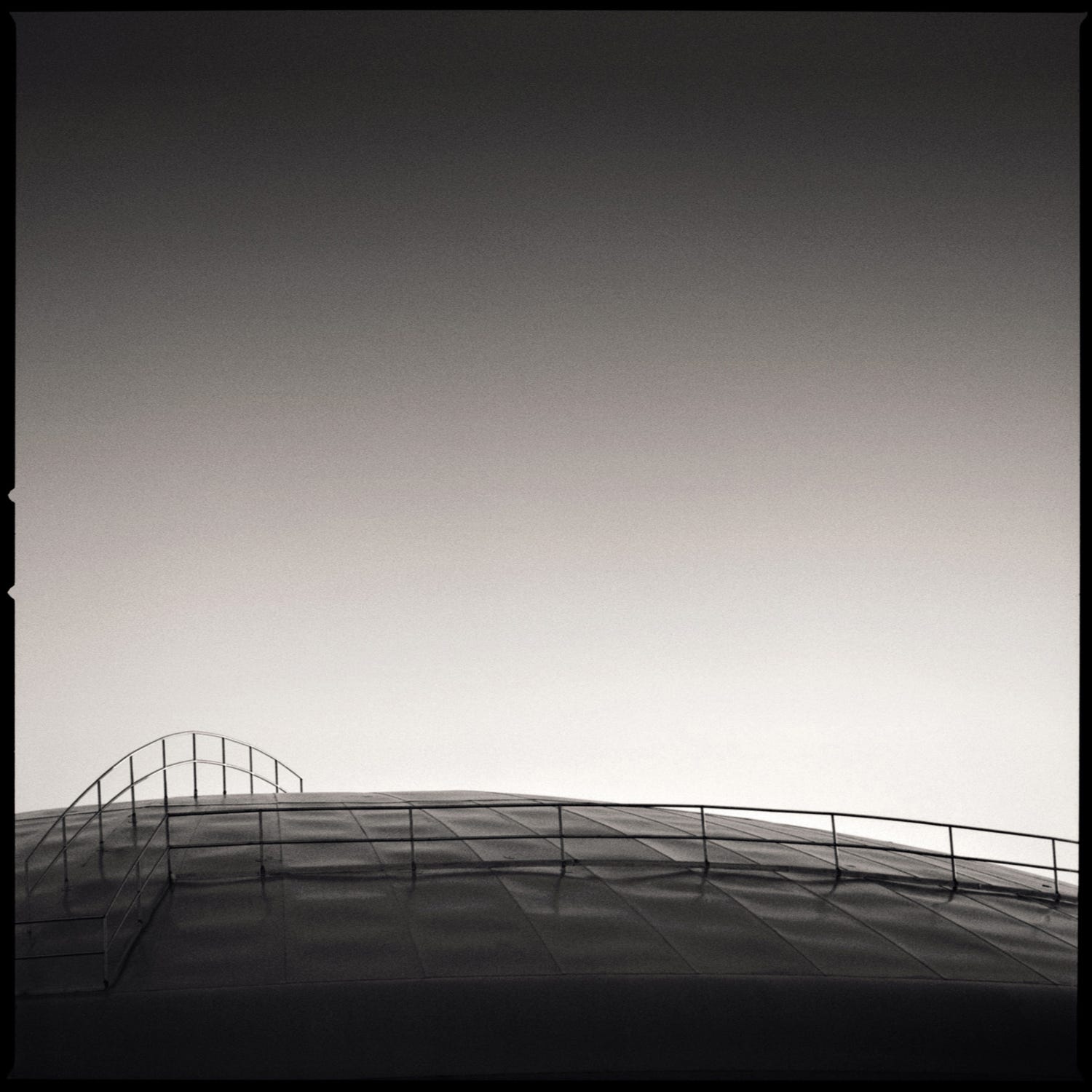
Opening photograph: Sea of Tranquility · from the series Transitory.